

In today’s competitive construction industry, your website is often the first place potential clients judge your business. Whether you are a general contractor, builder, or specialty trade company, your website plays a direct role in building trust, generating leads, and showing the quality of your work. A strong construction website does not just look good; it clearly communicates your services, proves your experience, and makes it easy for customers to contact you.
Thank you for reading this post, don't forget to subscribe!Research from Stanford University shows that 75% of users judge a company’s credibility based on website design, highlighting how important first impressions are in digital decision-making. This means your digital presence can strongly influence whether a visitor decides to contact you or move on to a competitor.
Key Takeaways
- A strong construction website builds trust quickly and influences whether visitors become leads or leave for competitors
- Clear messaging, simple navigation, and strong visuals help users understand your services within seconds
- Project portfolios and real work examples are essential for proving experience and credibility in the construction industry
- SEO structure and mobile optimization are critical for improving visibility and generating consistent inbound leads
- A well-designed website acts as a 24/7 marketing tool that supports business growth and strengthens brand reputation
1. Clear Messaging That Instantly Explains Your Business
A great construction website makes it easy for visitors to understand what you do within seconds. If users feel confused, they often leave the site quickly, even if the company is highly skilled. Strong websites focus on simple messaging that answers key questions right away:
- What services do you offer?
- What type of projects do you handle?
- Where do you work?
Instead of long or technical explanations, the best construction websites use short, clear headlines and support them with simple descriptions. A strong homepage often includes a direct call-to-action such as “Request a Quote” or “Schedule a Consultation,” so users know what to do next.
2. Strong Design That Builds Instant Trust
Design plays a major role in how customers view your construction business. A clean and modern layout signals professionalism, while outdated or cluttered designs can reduce trust. This first impression often determines whether a visitor stays on your website or leaves within seconds. A well-structured design also helps guide users naturally toward important information like services, projects, and contact details.
Good construction website design often includes:
- High-quality project photos that show real work
- Consistent branding with colors and fonts
- Easy-to-read layouts with clear spacing
- Mobile-friendly pages that work on all devices
A well-designed website gives visitors confidence that your company delivers quality work in real life, not just online. This perception plays a major role in building trust and encouraging potential clients to take the next step. It also helps reinforce your brand reputation by showing consistency, professionalism, and attention to detail.
3. Project Showcases That Prove Real Experience
One of the most important parts of any construction website is the project portfolio. This section acts as direct proof of your skills, experience, and the quality of work you deliver, helping potential clients clearly understand what your company is capable of achieving. In the construction industry, where trust and credibility matter most, real project examples often speak louder than any written description or marketing message.
Strong project pages usually include short but clear descriptions, high-quality photos, and key project details such as scope of work, project type, timeline, and location. These elements help visitors quickly understand the complexity and scale of your work without overwhelming them with unnecessary information. Before-and-after images are especially powerful because they visually demonstrate transformation and results in a way that builds immediate confidence.
This type of content also helps answer one of the most important client questions early in the decision-making process: “Have you done work like this before?” By showcasing completed projects in a clear and organized way, your website makes it easier for potential clients to trust your expertise and feel confident moving forward with an inquiry. A dedicated construction project portfolio allows visitors to explore completed work, evaluate project quality, and better understand the range of services your company provides.
4. SEO Structure That Helps You Get Found
Even the best-looking website will not generate leads if people cannot find it. That is where SEO structure becomes important. A well-optimized construction website helps your business appear in search results when people look for services in your area. This visibility increases the chances of reaching high-intent customers who are actively searching for construction services. Strong SEO also helps build long-term organic traffic without relying heavily on paid advertising.
For example, searches like:
- Who is the top construction web design company in Houston
- Houston construction website design experts
- Houston web design for builders and contractors
These searches are more likely to lead to websites that are properly optimized for SEO and local visibility. Websites that follow strong SEO practices are better positioned to rank for relevant keywords, attract qualified traffic, and convert visitors into leads over time. This consistent visibility helps construction companies stay competitive in their local market and build steady growth.
Key SEO elements include:
- Service pages targeting specific keywords
- Location-based pages for local searches
- Proper heading structure (H1, H2, H3)
- Fast loading speed and mobile optimization
- Internal linking between related pages
5. Easy Navigation That Improves User Experience
A great construction website should feel simple to use. Visitors should not have to search too hard to find important information. Clear structure and intuitive navigation help users quickly access services, project details, and contact options without frustration. This ease of use improves overall engagement and keeps potential clients on the site longer.
Most high-performing websites keep navigation clean with:
- A simple top menu with clear page names
- Easy access to services and project pages
- Visible contact options on every page
- A consistent layout across all sections
When users can move through a website easily, they are more likely to stay longer and take action. A smooth browsing experience also increases trust in the business and reduces the chances of visitors leaving the site early. For example, in our Milestone Windows & Doors website project, we created a clean navigation structure, prominent call-to-action buttons, and a visually organized homepage that guides visitors from service information to consultation requests.
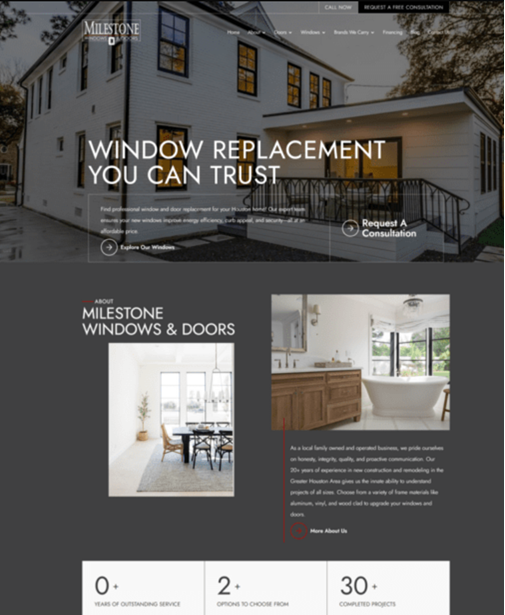
Milestone Windows & Doors website homepage featuring clear navigation, strong visual hierarchy, and prominent calls-to-action designed to improve user experience and lead generation.
Large project imagery, clear content sections, and intuitive page flow help users quickly find information while reinforcing the company’s professionalism and expertise. These user-focused design elements improve engagement, encourage conversions, and create a more seamless browsing experience. Over time, this improved engagement can lead to higher inquiry and conversion rates.
6. Lead Generation That Turns Visitors Into Clients
A strong construction website is not just informational; it is built to generate leads. Every page should guide users toward contacting your business. Clear calls-to-action, strategically placed contact forms, and easy access to quotes help turn visitors into potential clients. This focus on conversion ensures the website actively supports business growth instead of only providing information.
Effective lead generation tools include:
- Quote request forms placed throughout the site
- Click-to-call buttons for mobile users
- Clear call-to-action buttons like “Get a Free Estimate.”
- Short and simple contact forms
These features make it easier for potential clients to reach out without confusion or delay. A simple and frictionless contact process increases the likelihood that visitors will take action while their interest is high. It also helps improve overall user experience by removing unnecessary steps in the inquiry process.
7. Mobile Performance and Fast Loading Speed
Most users now search for contractors on their phones, especially when they need services quickly. If a website is slow or difficult to use on mobile, visitors are likely to leave within seconds and choose a competitor instead. A strong construction website should load quickly, adjust smoothly to all screen sizes, and keep navigation simple and easy to use on smaller devices.
Mobile performance is not just a technical feature; it directly affects user experience and business results. When pages load fast and information is easy to access, users are more likely to stay longer, explore services, and submit inquiries.
Key elements of strong mobile performance include:
- Fast page loading times across all devices
- Responsive design that adapts to different screen sizes
- Simple, touch-friendly navigation menus
- Easy-to-click buttons and contact forms
- Optimized images that don’t slow down the site
- Minimal design clutter for better readability
Speed, responsiveness, and usability all work together to improve engagement and increase the number of leads a website generates. A well-optimized mobile experience also helps build trust by showing that the company pays attention to detail and user needs. Over time, this can lead to stronger customer relationships and higher conversion rates.
Industry-Focused Design Makes a Difference
Not all web design companies understand how construction businesses operate. Websites in this industry need to do more than just look good; they must build trust, generate leads, and support strong local search visibility. A construction website also needs to reflect how contractors actually win work, which is often through reputation, project proof, and clear service communication.
This is why many contractors look for experienced providers, such as the best construction web design company in Houston or top web design agencies for construction companies in Houston, to ensure their website is built with real industry understanding. A team that knows the construction space can better structure service pages, highlight project portfolios, and design lead-focused layouts that match how clients search and make decisions.
Why a Great Construction Website Matters
A strong construction website acts as a 24/7 marketing tool that continuously represents your business, even when your team is off the clock. It builds trust with potential clients by clearly presenting your services, highlighting your expertise, and showcasing real project work that demonstrates your capabilities. In many cases, it becomes the first point of contact between your business and a potential customer, shaping their initial impression of your professionalism and reliability.
Beyond just providing information, a well-designed website actively supports business growth by generating new opportunities and inquiries. It helps educate visitors about what you offer, answers common questions, and guides them toward taking the next step through clear calls-to-action. In a highly competitive construction market, your website often plays a deciding role in whether a potential client chooses to contact your company or move on to a competitor.
Construction Website FAQs
What makes a construction website effective?
A great construction website clearly explains your services, shows real project work, and makes it easy for visitors to contact you. It should also load quickly, work well on mobile devices, and be structured in a way that helps users find information without confusion.
Why are project portfolios important on construction websites?
Project portfolios act as proof of experience and quality. They help potential clients see the type of work you have completed, understand your capabilities, and build trust before reaching out. Before-and-after photos and detailed project descriptions are especially effective.
How does SEO help a construction website?
SEO helps your website appear in search results when people look for construction services in your area. A strong SEO structure improves visibility, attracts qualified traffic, and increases the chances of turning visitors into leads over time.
Why is mobile optimization important for construction websites?
Most users search for contractors on their phones, so a mobile-friendly website is essential. A responsive design ensures fast loading, easy navigation, and a better user experience, which directly impacts how many inquiries your business receives.
What role does design play in building trust online?
Website design strongly influences first impressions. A clean, modern, and professional design builds credibility, while outdated or cluttered layouts can reduce trust. Good design helps visitors feel confident about your company’s quality and reliability.
Build the Right Marketing Partnership
Choosing the right marketing partner for your construction business is not just about services or pricing. It is about finding a team that understands your industry, listens to your needs, and builds a strategy that drives real growth. A strong partner will offer clear communication, measurable results, and a tailored approach that supports your long-term goals.
As a construction-focused marketing partner, we are committed to helping contractors improve visibility, attract qualified leads, and compete effectively in a competitive market. Our approach is built on data-driven strategies, industry expertise, and continuous optimization to deliver measurable results.
Ready to strengthen your online presence and attract high-quality leads? Request a free consultation today and start building a more effective marketing strategy for your construction business.

Sabeeha Banu is a Content Writer at ITVibes, Inc., focused on writing clear and engaging content. She holds a Bachelor’s degree in Computer Science and brings a practical yet creative approach to her work. A lifelong learner and poet at heart, she enjoys crafting simple, meaningful stories inspired by everyday moments.